
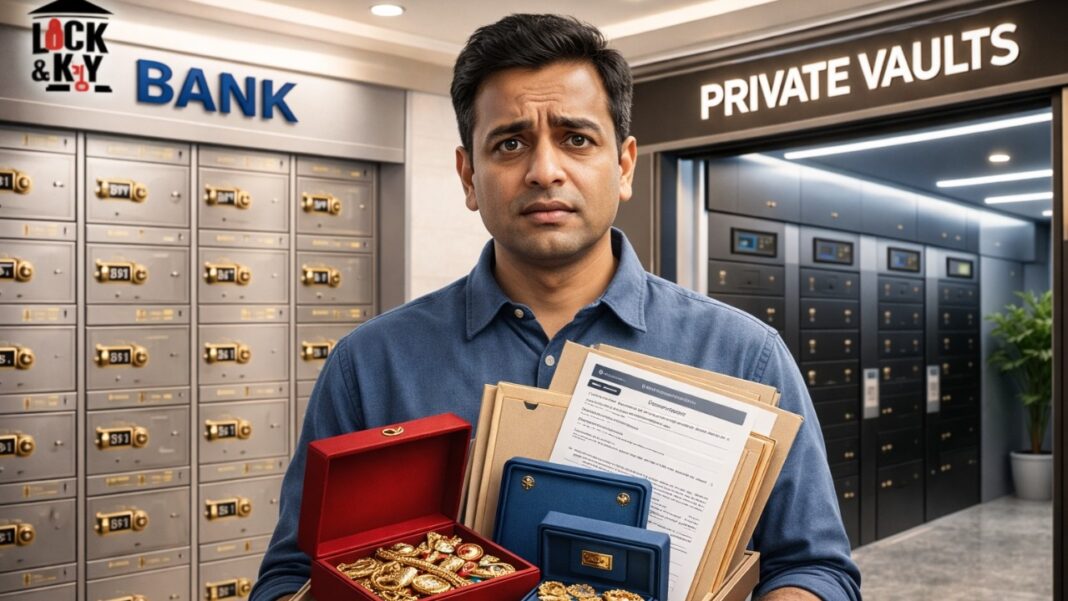
Getting a bank locker is no longer a routine banking request. Customers are often told there is a waiting list, with no clear timeline for when a locker might become available.
This growing shortage is forcing many to ask a basic question: if bank lockers are getting harder to access, where should people keep their valuables?
This is the third part of Lock & Key, a series that looks at how India’s bank locker system works, the risks involved, and what customers need to know. After examining safety and insurance in the first two parts, this story focusses on a new problem – access.
WHY BANK LOCKERS ARE HARD TO GET IN INDIA
The shortage of lockers is not accidental. It is the result of demand rising sharply while supply remains limited.
“Due to gap between demand and supply the availability of bank lockers has declined dramatically,” said Abhishek Kumar, SEBI Registered Investment Adviser and founder of Sahaj Money.
“In metros due to limited physical space in bank branches and high real estate costs the problem is more acute.”
India’s growing wealth and strong preference for holding gold are key drivers of this demand.
“We feel it’s a mix of both,” Kumar said.
“While demand has gone up due to increased purchasing power and gold ownership among affluent Indians, banks are also actively restricting issue of new lockers to manage liability risks, compliance burdens, and the unprofitable nature of locker services.”
WHY BANKS ARE NOT EXPANDING LOCKERS
Unlike loans or deposits, lockers are not a profitable business for banks.
“The main problem is that lockers are not a high profit business for banks, leading them to limit vault expansion in favor of more lucrative financial services,” Kumar said.
At the same time, setting up and maintaining locker facilities is expensive.
Banks need secure vault infrastructure, surveillance systems, physical space in branches.
In cities where real estate is expensive, expanding locker capacity becomes even more difficult.
RBI RULES HAVE MADE LOCKERS SAFER AND COSTLIER
Recent RBI regulations have improved security but also added to operational costs.
“Between 2023 and 2025 RBI has implemented major changes including mandatory biometric access, continuous CCTV recording, SMS/email alerts for every locker access, and new written agreements,” Kumar said.
Banks are also required to:
maintain transparent waitlists
show locker availability
upgrade systems regularly
While these rules protect customers, they have made locker services more complex and expensive to run.
ARE LOCKERS BEING PRIORITISED FOR SELECT CUSTOMERS?
Many customers believe lockers are easier to get if they have strong banking relationships.
Kumar pointed out that such practices do exist informally.
“Many a times bank employees allocate lockers to those customers who buy financial products through the bank to extract value from locker-seekers,” he said.
However, officially, this is not allowed.
“RBI prohibits banks from linking locker allotment to any financial products,” Kumar said.
Banks can only take a deposit equivalent to three years of locker rent as security.
ARE BANK LOCKERS BECOMING A PRIVILEGE?
With fewer lockers available, access is becoming more selective.
“That’s quite possible,” Kumar said.
“Due to declining availability, higher rentals and the capping of bank liability, locker access is already becoming an exclusive privilege tied to financial products or specific customer relationships.”
This shift is affecting many customers.
“As a result, middle and lower income customers are facing problems in availing locker services,” he said.
WHAT CAN YOU DO IF YOU DON’T GET A LOCKER?
As bank lockers become harder to access, customers are increasingly turning to alternatives.
A growing number of companies now offer private locker facilities outside the traditional banking system.
Some of the key players include:
MySafe India, which operates in major cities with modern, tech-enabled locker systems
Aurm, which offers fully automated, 24/7 access vaults with Swiss-style security systems
Velvet Vaults Private Limited, based in New Delhi, focusing on secure storage for gold and valuables
“In such a scenario, customers can try using private locker services and vaults which offer 24/7 access, security, and insurance coverage,” Kumar said.
PRIVATE LOCKERS VS BANK LOCKERS
Private vaults offer certain advantages.
“Private vaults often offer better convenience through extended operating hours, superior biometric technology, and more responsive customer service,” Kumar said.
However, they also come with a trade-off.
“Banks are governed by strict RBI regulations, which provides a level of institutional security and standardised compensation that private entities may not always match,” he said.
WHY PRIVATE LOCKERS COST MORE
Private locker facilities are typically more expensive than bank lockers.
“Private lockers are generally more expensive because they invest heavily in advanced security infrastructure like 24/7 surveillance and sophisticated access controls,” Kumar said.
“They also charge a premium for the convenience of avoiding long waiting lists.”
INSURANCE STILL MATTERS
Even when using private lockers, financial protection remains important.
“It is highly advisable to insure the contents of a private locker because the facility provider’s liability is often limited by the rental agreement,” Kumar said.
“An independent insurance policy is the only way to ensure full financial recovery.”
The shortage of bank lockers highlights a deeper shift in how the system works.
Lockers are no longer a widely available banking service. Instead, they are becoming limited, regulated, and in some cases, harder to access for the average customer.
As demand continues to grow, more people may have to look beyond banks to store their valuables safely.
A bank locker was once considered a basic banking facility. Today, as availability shrinks, the bigger question is not just where to keep your valuables safe — but whether you can get a locker at all.


