
I remember the euphoria that followed the announcement of the results of the 1977 elections. Even 50 years have not dulled that sentiment. The Emergency had ended, and the pall of dictatorship lifted. Our vote had restored democracy. A new beginning lay ahead.
Something similar happened in Nepal earlier this month. The election results have shut the door on the past and opened a passage to a new future. It’s not just a fresh beginning. It feels like a new life.
Balendra Shah, popularly known as Balen, and his Rashtriya Swatantra Party (RSP) swept to an unbelievable landslide majority. They have won 182 seats out of 275, just two short of a two-thirds majority.
What makes this even more surprising — actually exhilarating — is that only 165 seats were directly elected. The Rashtriya Swatantra Party won 125. The remaining 110 were chosen by proportional representation. This hybrid system made it very difficult for any party to win an outright majority. Yet the RSP comfortably did.
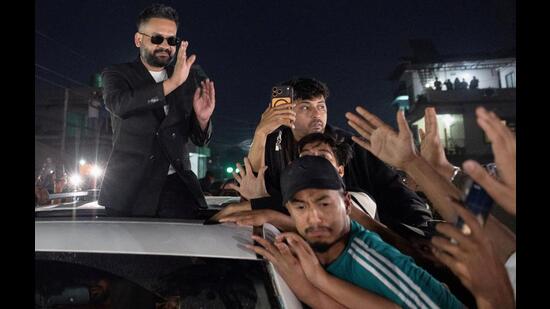
This means Balendra Shah, who’s only 35, will be Nepal’s new prime minister (PM). In the first instance, it was his image and personality that captivated Nepal. He’s a former rapper, famous for his critique of corruption and the social system. He’s also a former mayor of Kathmandu. In that job, at times ruthlessly, he cleaned up Nepal’s capital.
Balendra Shah did not give many interviews. That was probably wise of him. It meant the media couldn’t judge him. They had to rely on his reputation and image instead.
One critical aspect of this is how he bridges the divide between the hills and the plains. Though born a Madhesi, who often spoke Maithili, his hold on Kathmandu is unquestionable.
Alongside Balendra Shah is Rabi Lamichhane, the president of the RSP. He is, of course, the true architect of the RSP. But it was as a former TV anchor that he made his name. This is how he reached out to the Nepali people, touching their hearts, reflecting their troubles and echoing their aspirations.
In contrast to the RSP, the old Nepali political order has been decimated. Former PMs like KP Sharma Oli and Madhav Nepal have been defeated. Although Prachanda won, his daughter lost. This is a clear sign that Nepal has bid goodbye to the old guard. In its place, a new generation will rule. More technocratic and pragmatic, and a lot less ideological.
The biggest challenge facing the new government is the economy. In particular, jobs and the aspirations of the nine million young Nepalis who work abroad. The RSP has promised to create 1.2 million jobs, double the national income and provide health insurance for all. That won’t be easy.
Balendra Shah is a structural engineer who did his post-graduation at the Visvesvaraya Technological University in Karnataka. What sort of relationship will he seek with India? The auguries are propitious. He knows and understands India. He wants to draw on India’s help, not provoke its animosity.
But Balendra Shah will have to balance India alongside China, Nepal’s northern neighbour. How deft will he be at doing that? As yet we don’t know. But if he puts Nepal first, we should have few problems.
These are, of course, questions for the future. For now, there are huge expectations and a great sense of relief.
Don’t you sense a similarity with India in 1977? The Janata government, of course, bloomed to eventually disappoint.
Within three years, the Congress was back. Could something similar happen in Nepal? Could the promise of today become the heart-breaking disappointment of tomorrow?
The truth is, we don’t know. But there are reasons to believe history won’t repeat itself. For a start, the RSP is more united than Janata ever was. Second, Balendra Shah dominates his party in a way Morarji Desai could not. Third, there’s no Indira Gandhi lurking in the wings. Finally, Nepal is a smaller country and, unlike 1977 in India, the vote is not divided in regional terms. The older parties are just decimated. They won’t recover easily.
Karan Thapar is the author of Devil’s Advocate: The Untold Story. The views expressed are personal


