
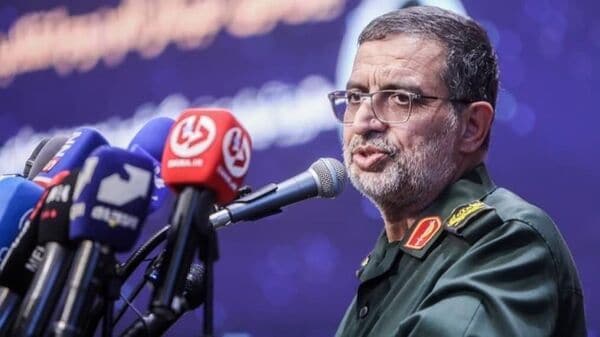
Israel killed Ali Mohammad Naini, a spokesman for Iran’s Islamic Revolutionary Guard Corps, in airstrikes on Friday, as the US–Israeli conflict on Iran showed no sign of abating. Prior to his death, Naini lauded Tehran’s missile programme, stating it “deserves a perfect score”.
Naini “was martyred in the criminal cowardly terrorist attack by the American-Zionist side at dawn”, according to the Guards statement on their Sepah News website.
According to the Fars news agency, Guards spokesman Ali Mohammad Naini said, “Our missile industry deserves a perfect score… and there is no concern in this regard, because even under wartime conditions we continue missile production.”
The remarks were made hours after Israeli Prime Minister Benjamin Netanyahu on Thursday that Iran’s capability to enrich uranium and to produce ballistic missiles has effectively been eliminated, as per AFP.
Who was Ali Mohammad Naini?
The 69-year-old, holding the rank of second brigadier general, served as the spokesperson for the IRGC starting in 2024. He succeeded Brigadier General Ramazan Sharif in the role, appointed by IRGC Commander-in-Chief Major General Hossein Salami.
A military veteran with 40 years of service, including participation in the Iran-Iraq War, General Naeini held several senior positions, such as the IRGC’s cultural deputy and the Basij’s cultural and social deputy. In 2024, he was among the top Iranian military officials sanctioned by the UK following Tehran’s attack on Israel.
A series of US-Israeli airstrikes that began on February 28 have killed several top Iranian officials, including Supreme Leader Ayatollah Ali Khamenei. Other high-ranking figures affected include Ali Larijani, secretary of the Supreme National Security Council; Iran’s intelligence minister, Esmail Khatib; Ali Shamkhani, an adviser to Khamenei involved in security and nuclear policy; Mohammad Pakpour, an IRGC commander; and Gholamreza Soleimani, head of the IRGC’s Basij paramilitary force.
Meanwhile, Iran on Friday threatened to target recreational and tourist sites worldwide while reaffirming its ongoing missile production, reported AP.
Iran’s top military spokesman, Gen. Abolfazl Shekarchi, warned that “parks, recreational areas and tourist destinations” worldwide would not be safe for Tehran’s adversaries.
The statement came nearly three weeks into US-Israeli strikes that have killed many of Tehran’s top officials and damaged its weapons and energy infrastructure.
Iran launched attacks on Israel and energy facilities in neighboring Gulf Arab states during one of the holiest days in the Muslim calendar, coinciding with Nowruz, the Persian New Year, which was subdued this year.
With limited information emerging from Iran, the extent of damage to its arms, nuclear, or energy facilities since the conflict began remains unclear, as does the current leadership structure. Nonetheless, Iran has demonstrated its ability to carry out strikes that disrupt oil supplies and affect the global economy, driving up food and fuel prices beyond the region.
Following Israel’s bombing of Iran’s South Pars offshore gas field, Iran intensified attacks on Gulf energy infrastructure. Early Friday, two waves of drones targeted the Mina Al-Ahmadi oil refinery in Kuwait, causing a fire; the facility can process roughly 730,000 barrels per day and had also been hit in a prior attack on Thursday.
In Bahrain, shrapnel from an intercepted projectile ignited a warehouse fire, while Saudi Arabia reported intercepting multiple drones aimed at its Eastern Province oil facilities.


