
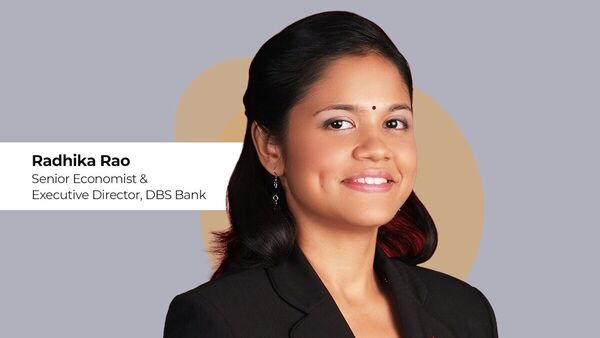
The US-Israel military operation against Iran, which began on 28 February, has spooked the financial markets and global trade. With attacks extending to energy infrastructure, including gas facilities and production sites in the Gulf, governments and financial markets fear that the conflict may escalate further. In an email interview with Livemint, Radhika Rao, senior economist & executive director, DBS Bank,shares her views on the likely impact of escalating Middle East tensions on interest rate changes.
She also gives her reasons explaining why this conflict is unlikely to disrupt the structural strengths of the Indian economy. She spoke about her expectations for the future price movement of the Indian rupee, which has been on the back foot even before the conflict started.
Rao highlighted why ‘diversification’ in the mix of trading and investment partners is important for India to become a $10 trillion economy. The economist also elucidated how a trade deal with the US would open new opportunities for Indian exporters.
Edited Excerpts
Amid growing tensions in the Middle East, do you think the Reserve Bank of India (RBI) would opt for a repo rate cut in 2026?
The RBI monetary policy committee had lowered benchmark rates in 2025 by utilising the then- available real rate buffer, even as the growth momentum was firm. As this window narrowed, we maintained our baseline view of a prolonged pause beyond December 2025. More recently, escalating tensions in the Middle East and resultant risks from pipeline inflationary pressure further cement our view that the MPC will prefer to keep rates unchanged.
A weaker rupee adds to that conviction, as the risk of imported price pressures has also increased in light of the sharp rally in global crude prices. An extended conflict will introduce inflationary pressures via retail fuel price adjustments (on direct pass-through), higher costs of industrial raw materials, transportation, and derivative products, besides second-order effects.
Multiple wars (Russia-Ukraine and US-Israel-Iran) are happening around the world. Where is the Indian economy headed against this backdrop?
Ongoing global conflicts do introduce short-term risks to price stability and development plans, but we do not expect these geopolitical tremors to derail the structural and strategic strengths of the economy. Authorities are expected to build on the domestic-driven nature of growth, by keeping capital spending plans on track and promoting growth in medium-to-high tech sectors like semiconductors, electronics, renewables, and defence manufacturing.
Prior to the recent Middle East tensions, consumption was exhibiting signs of resilience, and we expect that to sustain when the external hostilities are scaled back. India’s geopolitical positioning in light of several trade agreements and supply chain realignment will also make the recovery more durable, as we maintain our growth forecast for FY27 with modest downside risks.
The rupee internationalisation plan, set rolling by trade settlements, will also be expedited to lower the impact of volatility through USD-based FX channels.
Rupee has been getting weaker day by day. What are your views on the future trajectory of Indian rupee?
The rupee was already on the back foot before tensions in the Middle East intensified, with a swift move to fresh lows driven by a bid US dollar and broader risk aversion. The ongoing conflict has worsened vulnerabilities in trade and current account, aggravated by weak flows as investors have trimmed exposure to emerging markets amid demand for safe-haven assets.
Beyond the near-term volatility due to external triggers, we expect the currency to be maintained at competitive levels and in undervalued territory, with the rupee real effective exchange rate holding below 100 since the last quarter.
This is occurring at a time when a narrow current account deficit has lowered the reliance on foreign flows compared to the taper tantrum period, though weak flows will keep the balance of payments in the red in FY27.
One of DBS Bank’s reports mentions that four key forces (known as 4Ds—development, diversification, digitalization and decarbonization) would shape India’s path to a $10-trillion economy. Which one is the most underrated and underacknowledged?
Diversification stands out, from the point of view of widening manufacturing activity, shifting strategic priorities as well as expanding the mix of trading and investment partners. Recent bilateral trade deals outside of the US are expected to strengthen ties with Europe, the UK, and select Pacific countries when the ratification process is complete.
India and the US announced the bilateral trade deal in February. Do you believe that this would boost India’s exports to America in 2026, or will the overall benefit remain limited?
India has indicated that the trade deal with the US will stay despite the IEEPA court ruling, as the terms are seen as conducive to both parties. Better market access for India’s exporters in labour-intensive sectors will also be key, especially where the previous tariff/ non-tariff barriers had given neighbouring South Asian countries an edge. Deeper tech collaboration will also be a big plus in aerospace and defence capabilities, AI and clean energy technologies.


