
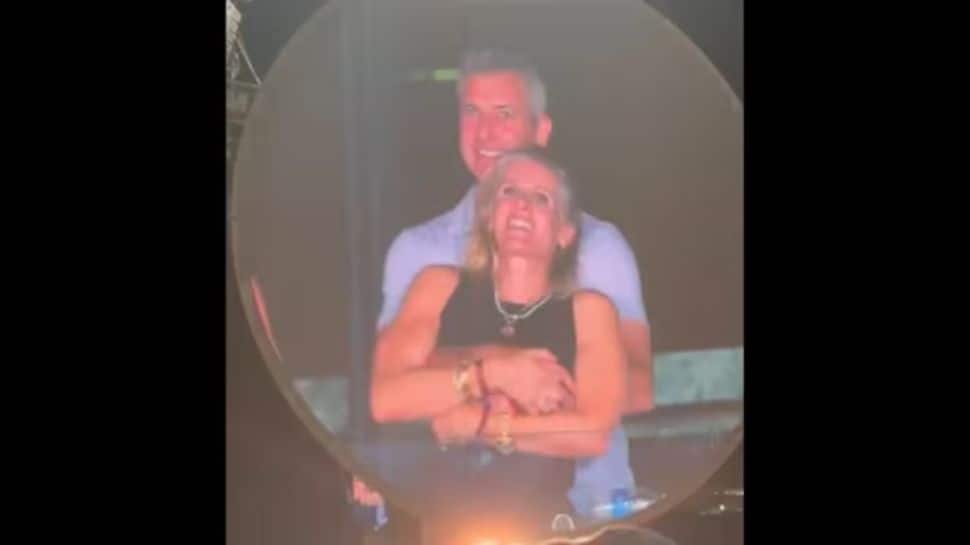
Coldplay Kiss-Cam Scandal: What was supposed to be a night of music and lights at a Coldplay concert in July 2025 turned into one of the most talked-about controversies of the year. The incident grabbed attention well beyond the music world.
Kristin Cabot, a former human resources executive at tech firm Astronomer, has publicly accused her former boss, Andy Byron, of deception in what some observers are now questioning as a carefully orchestrated spectacle rather than a spontaneous kiss-cam moment.
The incident itself appeared innocuous at first. During the concert, the stadium’s massive screen focussed on Cabot and Byron sharing a seemingly romantic exchange. As the camera zoomed in, Cabot instinctively covered her face while Byron quickly stepped out of view.
Lasting barely seconds, the clip spread across social media almost instantly, attracting millions of views and thousands of comments. Martin, Coldplay’s lead singer, was heard quipping, “Either they are having an affair or they are just very shy,” before the camera cut away.
On the surface, the narrative seemed straightforward: a brief, embarrassing moment captured live in front of thousands. But Cabot’s revelations in a recent podcast interview with Oprah Winfrey suggest a much deeper story. She claims that Byron had misrepresented his personal situation to her, implying he was separated from his partner at the time.
“There was a big miss on honesty and integrity. He was not the person he represented himself to be to me. And lying is a non-negotiable for me,” she said.
It was this alleged personal betrayal that became the public drama, but some online theorists argue there is more beneath the surface. Cabot’s supporters and conspiracy enthusiasts have questioned whether the timing and optics of the kiss-cam moment were purely coincidental.
Could the clip have been manipulated, or even encouraged, to humiliate her in front of millions – exploiting the reach of social media for reasons beyond mere chance?
The fact that Cabot lost her job at Astronomer shortly after the viral clip fuels further speculation.
Some analysts suggest that the incident may be symptomatic of a larger pattern of corporate leverage in the digital age. Social media platforms thrive on viral content, and moments like this generate massive engagement, often at the expense of personal privacy and professional reputation.
Cabot herself criticised technology companies for “profiting” from her distress. The statement resonates with a growing public awareness of how corporate and media interests can intersect with personal lives.
The conspiracy theories extend even further. Several commentators have speculated whether Byron had insider knowledge of the camera angles and stadium programming, implying a deliberate orchestration rather than an accidental capture.
Was it possible that the Coldplay production team, unwittingly or not, contributed to a scenario designed to go viral to amplify a personal betrayal into a public spectacle? While no concrete evidence has been presented, the rapid proliferation of the video and the precise moment it captured suggest a level of timing that some find difficult to dismiss as coincidence.
Adding another layer, observers have said how quickly online commentary has influenced the narrative. The clip’s virality along with Cabot’s public revelations created a feedback loop. In this loop, social media, celebrity commentary and corporate dynamics collided, blurring the lines between private grievance and public theater.
In this context, the kiss-cam moment becomes more than a fleeting embarrassment; it is a lens through which questions about privacy, power and digital exploitation can be examined.
Cabot says that her goal is not to attack Byron personally, but to highlight the consequences of dishonesty and manipulation in both personal and professional spheres. But the enduring fascination with the incident, fuelled by viral algorithms and public speculation, has turned an isolated event into a cultural flashpoint.
Whether the kiss-cam moment was a spontaneous snapshot or a calculated spectacle, it has sparked a wave of questions about trust, media influence and the ways in which personal lives can be weaponised in the era of social media.


