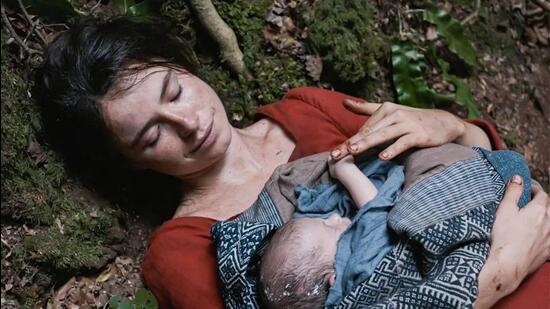
In one of Hamnet’s most harrowing scenes, Agnes Shakespeare (Jessie Buckley) lets out a guttural wail of distress after watching her young son, violently convulsing and in agony, die. Though Buckley told reporters that she had “no idea” where the scream came from on that day, director Chloe Zhao pinpointed its origin in interviews — the vast prep work the actor undertook prior to filming, which involved speaking to women who had lost a child. Buckley’s astute channelling of maternal grief and trauma won her the Oscar for Best Actress at the Academy Awards held on March 15 in Los Angeles — the first for the 36-year-old Irish actor.
Hamnet is among a handful of films that was nominated for an Oscar this year, in which unvarnished and unflinching portraits of motherhood reveal some of society’s deepest anxieties: is gender fixed; and, if it isn’t, what happens to this most holy of gender-based roles? These aren’t questions asked in Rosemary’s Baby (1968) — widely considered to be the first mainstream film to feature pregnancy horror — in which even the terrifying revelation that she was unknowingly impregnated by Satan isn’t enough to stop Rosemary Woodhouse’s (Mia Farrow) maternal instincts from kicking in once the baby is born.
For many, watching a woman’s flawed humanity override a social stereotype is still destabilising: consider online sentiment that the characters in these Oscar-nominated films are “bad mothers”, and not simply women trying their best and still failing. These films, however, are a natural progression of those made in 2024 that depicted pregnancy as body horror — Immaculate, The First Omen, Apartment 7A to name a few — and taken together, reflect the collective anger of a country in which women’s rights are under attack and their reproductive choices curtailed, exacerbated most recently by the momentous 2022 American Supreme Court’s reversal of the Rowe v. Wade and Planned Parenthood judgements, both of which legalised abortion in the early 1970s. One Battle After Another makes the most direct allusion to this — in one scene, a senator who votes for an abortion ban has his office bombed outright by activists. The film secured 13 nominations and six wins, including Best Picture and Best Director for Paul Thomas Anderson.
In If I Had Legs I’d Kick You, the harried Linda (played by Rose Bryne, who lost out to Buckley for Best Actress on Sunday) must perform a number of roles — therapist, tenant, and above all, mother — attending to each with increasing urgency. Her house is in desperate need of repairs, the clients she sees as a therapist each come with their own stories to recount, and her young daughter suffers from an unidentified illness that necessitates an abdominal feeding tube. Bit by bit, Linda cracks until she can’t speak in any other register but a scream, so frustrated at not being heard. Eventually, speaking of a previous abortion, she bursts out: “I’m not one of those people who’s supposed to be a mom.”
Likewise, the incendiary spirit of activist Perfidia Beverly Hills in One Battle… played by Teyana Taylor (who was nominated for Best Supporting Actress) chafes against the restraints of domesticity imposed on her once she gives birth. For a woman who comes from a long line of revolutionaries as her character does in this dark comedy action thriller, merely staying at home is unthinkable. “We have her,” says her husband Bob (Leonardo DiCaprio), talking about their child. But it’s no substitute for her actual vocation.
These are desperate times, and women are driven to the brink: one of Linda’s troubled clients goes to the bathroom during a session but never returns, abandoning her infant alone with the therapist. Later, she emails Linda a video of Andrea Yates, the Texas woman who developed postpartum psychosis and drowned her five children in 2001. Part of the email reads, simply: “I am not trying to be her.” In drawing from real-life tragedy, the film evokes our empathy, and makes it less likely for maternal mental health concerns to be dismissed.
The film was born out of director Mary Bronstein’s own experiences of caring for her sick daughter, reflected in the insistent, needy stream of “mom, mommy, mom” that soundtracks Linda’s day. Even the camera pushes in close to her face, yet another invasion of her space. There’s no respite. A burst pipe causes Linda’s apartment ceiling to cave in, flooding the floors: an apt metaphor for a mother who feels like she’s drowning. Linda’s infuriatingly oblivious husband only makes things worse when he calls by either talking about all the fun stuff he’s getting to do while away on his work trip, or everything Linda must be doing wrong back home.
Why is the man absent? Because patriarchy imagines motherhood as an inherently lonely, alien experience. If it does not come naturally to a woman, all failure adheres to her alone.
The theme of absent fathers continues in Hamnet, nominated for eight Academy Awards, including Best Picture and Best Director for Zhao. Based on the best-selling 2020 Maggie O’Farrell novel of the same name which dramatises William Shakespeare’s life, the film pinpoints his unavailability at two critical junctures: he isn’t there when his son Hamnet is born, and he isn’t there 11 years later when the boy dies of bubonic plague. The playwright adores his children, but creative fulfillment ranks higher. Early on, his tantrum over a play not coming together wakes up his infant, which of course, his wife Agnes bears the responsibility of then soothing. She advocates for him to go to London and pursue a career, discerning that he “needs more”, a sentiment few mothers express. Just ask Perfidia.
The revolutionary is wracked by the physical toll of being a new mother — “I feel ugly, my nipples hurt,” she cries — and its seismic psychological impact. She not only begins to resent how her baby has usurped her place in Bob’s affections, but also outright rejects his assertion that her priorities should now be different too. “I put myself first and I reject your lack of originality,” she fires back, unblinking. She ultimately flees to Mexico after her arrest, abandoning both husband and child. The film ends with her now-teenage daughter reading a letter from her, in which she apologises and wishes for them to meet someday when it’s safe.
Unlike the women of If I Had Legs… and Hamnet who live for their children, Aunt Gladys (Amy Madigan, who won Best Supporting Actress) of the breakout horror film Weapons lives off them, the archetypal witch who drains their life so as to extend her own. By adopting a maternal persona as a means of manipulation, the film offers a neat contrast to the ideal self-sacrificial mother, and to the millions of American women expected to live their lives devoid of choice over what they can do with their own body.