
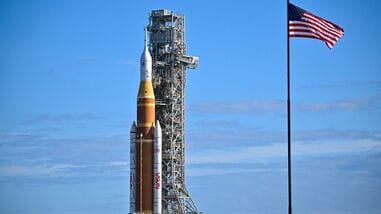
If everything goes well, the much-awaited Artemis mission is expected to launch on April 1 (Wednesday). This will be NASA’s first crewed mission of the Artemis programme. For the first time in 50 years, four astronauts will fly the Orion spacecraft around the Moon and back to Earth during a 10-day mission.
Artemis II SLS rocket roll-out tonight!
NASA, on Wednesday (March 18), finalised the Artemis II roll-out.
NASA is now targeting 8 PM EDT on Thursday, March 19, (5:30 AM IST on Friday) to start rolling the Artemis II SLS (Space Launch System) rocket and Orion spacecraft to Launch Pad 39B at Florida’s Kennedy Space Center — in advance of a launch attempt on April 1.
The journey can take up to 12 hours. One can watch it on NASA’s YouTube channel.
NASA, however, mentioned in a press release that the time of the rollout “is subject to change if additional time is needed for technical preparations or weather accommodations”.
The US’ historic Artemis programme has undergone several changes in the past few months. Here’s all the latest you need to know about NASA’s upcoming moon mission:
1. The Artemis II mission is slated for launch on April 1. The early April launch window includes opportunities through Monday, April 6. Recently, NASA added April 2 (Thursday) as a potential launch date for Artemis II. Earlier, NASA had aimed to launch it as early as February 2026.
2. NASA had targeted March 19 for the rollout, but later pushed that to March 20 after additional maintenance on the rocket was required. Now, it seems that work was completed faster than expected as NASA is once again targeting March 19.
3. The four Artemis II crew entered quarantine at 5 pm CDT Wednesday in Houston, to ensure they stay healthy leading up to launch.
“NASA astronauts Reid Wiseman, Victor Glover, and Christina Koch, along with CSA (Canadian Space Agency) astronaut Jeremy Hansen, will limit their exposure to others for the next week in Houston, before flying to Kennedy approximately five days before launch, to continue their quarantine from the astronaut crew quarters there,” the agency said.
4. In February, NASA made a major change in its Artemis programme. Now, the Artemis III mission will test one or both commercial landers from SpaceX and Blue Origin, respectively, and, with Artemis IV, NASA continues to target the first Artemis lunar landing in early 2028.
Artemis V is expected to be launched by “late 2028, and future missions about once per year thereafter.” With this mission, NASA is also expected to begin building its Moon base.
5. NASA also revealed the details of what the astronauts, who would be first to fly on the Artemis moon mission, would do during the 10-day mission.
What makes Artemis 2 important?
Artemis 2 is a part of NASA’s programme to land humans back on the lunar surface, almost five decades after the Apollo programme made history. This time, they will explore the South Pole of the moon (Artemis IV).
NASA said that the mission is a critical step in the Artemis programme, aiming to establish a long-term human presence on the Moon and prepare for future missions to Mars.
The Orion spacecraft will orbit Earth several times, then embark on a four-day journey to the Moon, fly around Earth’s natural satellite, and return to Earth.
“This mission will potentially send astronauts farther into space than any human has travelled before – around the Moon and safely back home,” NASA Administrator Jared Isaacman said.
India’s Gaganyaan mission
NASA’s Artemis mission to land humans on the moon coincides with India’s Gaganyaan programme, which aims to achieve an indigenous human spaceflight capability in low Earth orbit, aiming for a 2027-2028 crewed launch. As part of this programme, two unmanned missions and one manned mission have been approved by the Government of India.
China is also targeting a crewed lunar landing by 2030, and it, alongside Russia, is developing the International Lunar Research Station (ILRS).


