
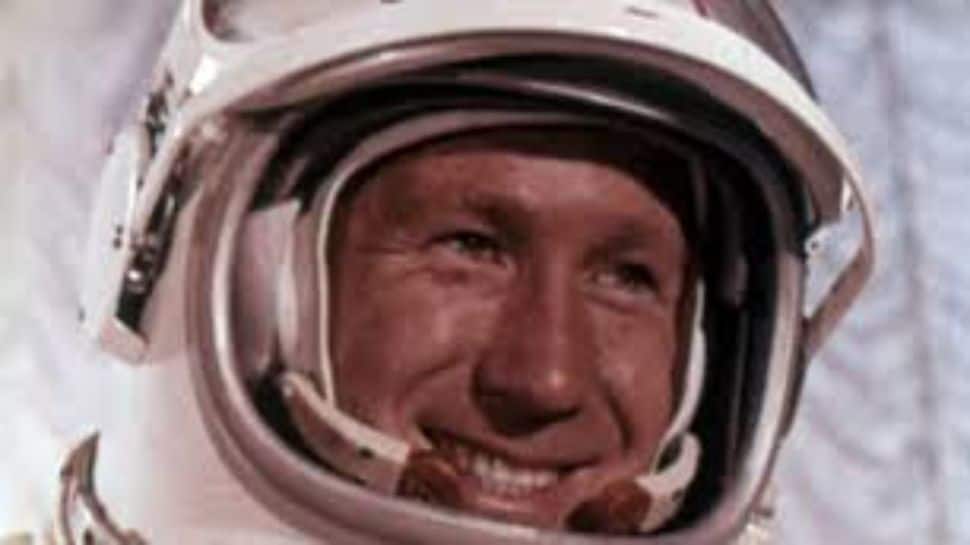
New Delhi: On this day (March 18, 1965), humanity stepped beyond the safety of a spacecraft and entered the silent void of space. Tethered to the spacecraft by a slender lifeline, Soviet cosmonaut Alexei Leonov floated outside his capsule for over 12 minutes. The Soviet Union celebrated it as a technological triumph. The world saw it as a defining moment in the Cold War space race.
However, what is hidden behind the official story has led to decades of speculation, rumors and questions about what really happened that day and why the United States appeared unusually restrained in its response.
The mission was daring and dangerous. Leonov and commander Pavel Belyayev took off from Baikonur Cosmodrome in the spacecraft Voskhod 2, carrying the dreams of their entire country. At precisely 11:34 a.m. Moscow time, he exited the airlock and became the first human to walk in the space.
According to Soviet records, everything went smoothly. Leonov floated in space, took pictures and said he was fine. His spacesuit kept him safe in both extreme heat and freezing cold. The 12-minute spacewalk was recorded in history as a perfect success.
But declassified documents and later interviews show a much scarier story. In space, Leonov’s suit started to swell. It became stiff and hard to move in. His gloves and boots stopped working properly, and his body temperature went up fast. It got so bad that he could barely fit back into the spacecraft.
Confronted with a life-or-death situation, Leonov acted out of sheer necessity. Hoping to get back inside, he opened the pressure valves on his suit, a move that could have led to a fatal case of the bends. The decision paid off, and he stumbled back into the capsule exhausted, drenched in sweat and on the verge of blacking out.
This near-disaster raises an uncomfortable question. If the mission nearly ended in disaster, why did the world hear such a clean and polished story?
The answer may lie in the geopolitical tension of the time. Science was never the focus of the space race. Under the direction of organisations like NASA, the Soviet Union and the United States engaged in psychological warfare, dominance and perception. Every success or failure was used to send a political message.
Several historians argue that American intelligence had access to far more detailed telemetry data than was publicly acknowledged. Monitoring stations across the globe, including those operated by the United States, were capable of tracking Soviet missions in real time. Signals, radio chatter and anomalies could have been intercepted and analysed.
What emerges from this line of thought is a controversial theory. Washington may have known that Leonov’s mission nearly ended in tragedy but chose not to keep mum. Publicly exposing it would have risked revealing the extent of US surveillance capabilities during the Cold War. And silence served a strategic purpose.
At the same time, American space scientists were racing to conduct their own spacewalk under Neil Armstrong’s broader era of missions. Acknowledging Soviet vulnerabilities could have disrupted the carefully managed narrative of competition and progress that kept funding and political support coming.
Leonov himself later admitted that the mission was far more dangerous than anyone realised at the time. His survival depended on improvisation, courage and a willingness to defy protocol in a moment of crisis.
The first spacewalk is one of humanity’s biggest achievements. It also shows that history is often made to look smooth and perfect. Behind the iconic images of a man floating above earth is a story full of danger, secrecy and Cold War rivalry, where even the truth could become collateral damage.


