
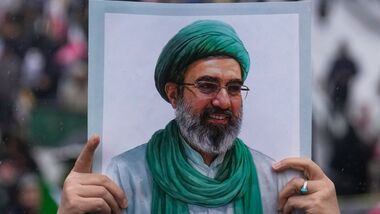
Iran’s Supreme Leader, Mojtaba Khamenei, on Wednesday (local time) reacted to the killing of Ali Larijani, the country’s Supreme National Security Council, saying that “criminals have to pay soon for his blood,” Reuters reported.
Khamenei’s remark came hours after Tehran confirmed that the leader was killed in Israeli strikes. Earlier on Tuesday, the Israeli military said that it had killed Larijani along with Gholamreza Soleimani, the chief of the Islamic Revolutionary Guard Corps (IRGC) Basij unit, a volunteer paramilitary force.
Larijani’s killing marks an escalation in the war between the US, Israel, and Iran, which is now in its third week. According to a Reuters report, he was killed by a US-Israeli air attack as he was visiting his daughter in the eastern outskirts of a Tehran suburb.
Who was Ali Larijani?
Larijani, who was one of the most powerful figures in the Islamic Republic, was considered an architect of its security policy. He was a close advisor of the former Supreme Leader Ayatollah Ali Khamenei until he died in an airstrike last month. He belonged to a prominent clerical family whose brothers rose to senior roles after the 1979 Islamic Revolution. Larijani was regarded as a shrewd and pragmatic figure, yet firmly committed to preserving the country’s theocratic system of governance.
He also served as an IRGC commander during the Iran-Iraq war in the 1980s and soon became chief of Iran’s national broadcaster and went on to head the Supreme National Security Council, both before and after his time in parliament, where he served as speaker for 12 years.
He was Iran’s most influential powerbroker, and his killing has pushed the Islamic Republic into a more uncertain phase, further complicating decision-making in Tehran and limiting its options as the war rages on.
Tehran loses key leaders in the war
The US and Israel waged a war against Iran in late February and targeted the country’s military and naval forces. In the last three weeks, Tehran has lost several of its top leaders, including the defence minister and intelligence minister. According to a Reuters report, after the strikes began in February, Larijani was one of the first major Iranian figures to speak and accused Tehran’s attackers of seeking to disintegrate and plunder the country.
The ongoing war has plunged the Middle East region into a wider and renewed military confrontation, with Tehran retaliating and targeting US military installations across the Middle East. The conflict has further sent the aviation and global energy market in for a tailspin, with oil prices touching $120 a barrel last week before retreating, compelling the International Energy Agency (IEA) to intervene and quell the fears of supply disruption. This came after Tehran’s IRGC announced the closure of the Strait of Hormuz, days after the war broke out. The Strait of Hormuz is a narrow waterway between Iran and Oman, and is responsible for nearly one-fifth of the world’s oil supply.


