As India expanded its higher education system over the years, getting a degree became easier in terms of availability—but not always in terms of affordability.
The cost of professional education has risen steadily, especially for students who are unable to secure a seat in a government college. Government institutions still offer relatively low fees, but limited seats mean that many students are pushed towards expensive private colleges.
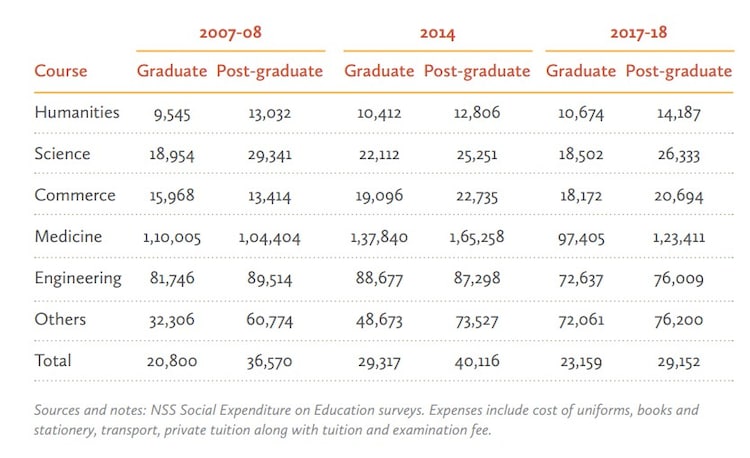
The State of Working India 2026 showed that this rising cost has made professional degrees like engineering and medicine difficult for poorer households to afford.
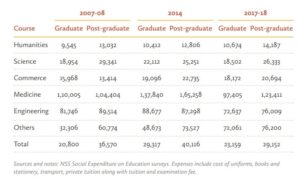
As far back as 2017–18, the average annual cost of a medical degree was around Rs 97,400, while engineering cost about Rs 1,23,000 per year.
These are average figures, and costs in private colleges today are often much higher, making access even more unequal.
Even though more students are entering higher education, not everyone is entering the same types of courses.
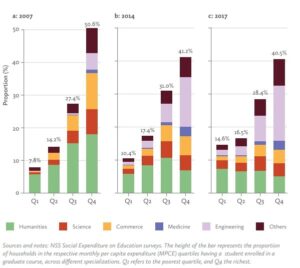
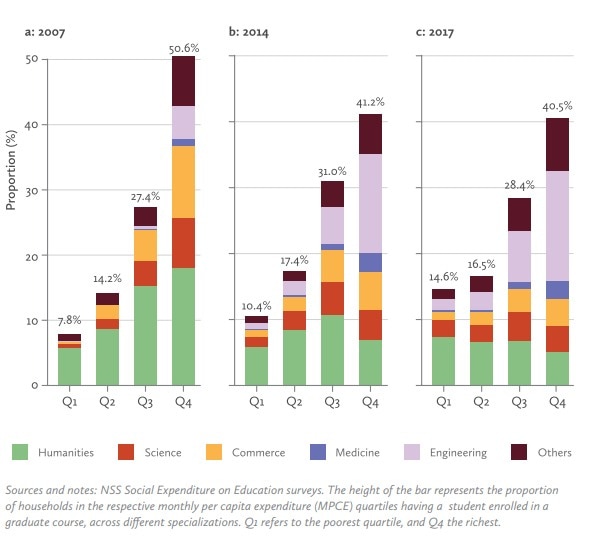
The report highlighted that students from richer households are far more likely to enrol in professional courses like engineering and medicine. These courses are known to offer better earning potential and more stable job opportunities.
On the other hand, students from poorer households are more likely to study commerce or humanities, which often have lower costs but also lower returns in the job market.
GROWTH WITHOUT EQUAL ACCESS
There has been some improvement over time. In 2007, only 22 per cent of students in higher education came from the bottom two income groups.
By 2017–18, this share had increased to 32 per cent. This shows that more students from poorer families are entering colleges. However, this increase does not mean equal access to all types of courses. The gap remains wide when it comes to professional degrees.
The divide between rich and poor students has actually grown stronger in terms of course choice. Wealthier students continue to dominate high-cost, high-return fields like medicine and engineering.
Poorer students, even if they reach college, are often unable to enter these streams due to financial limits.
THE REAL COST OF PROFESSIONAL DEGREES
The cost of professional education is not just about tuition fees. Students also have to spend on coaching classes, entrance exams, travel, and accommodation.
These extra expenses can significantly increase the total cost of education. For competitive exams, coaching alone can cost tens of thousands of rupees each year, adding pressure on families.
For poorer households, these costs are often too high to manage.
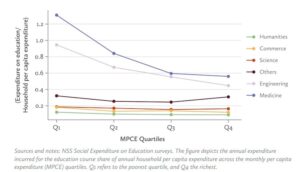
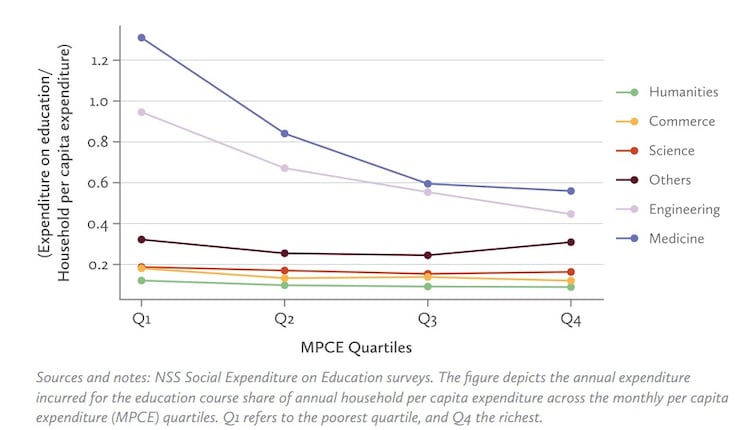
The report clearly pointed out that if education spending is compared to a household’s per person annual expenditure, then the cost of pursuing professional degrees like engineering and medicine exceeds what the poorest families can afford in a year. This makes such courses almost impossible to pursue without financial support.
By 2017–18, a large share of graduate students, around 41 per cent, still came from the richest households, even though this dominance had slightly reduced over time.
In contrast, the share of students from the poorest quartile nearly doubled, rising from 8 per cent in 2007 to about 15 per cent in 2017.
DOUBLE DISADVANTAGE FOR POOR STUDENTS
Students from low-income backgrounds face two major challenges.
First, they find it harder to enter higher education due to financial and social barriers.
Second, even if they manage to enrol, they are less likely to choose professional courses because of their high cost. This creates a double disadvantage.
As a result, poorer students are often left out of courses that lead to higher-paying jobs. This limits their chances of improving their economic condition and keeps inequality in place across generations.
Professional degrees are not just about education, they are closely linked to future income and job security. When access to these degrees depends on a family’s financial background, it creates an uneven playing field.
Those who can afford the costs move ahead, while others are left behind despite having the ability.
JOB OUTCOMES AND FINAL THOUGHT
The report also noted that professional courses are seen as pathways to stable and better-paying jobs.
This makes the unequal access even more concerning. If only wealthier students can enter these fields, then the benefits of economic growth are not shared equally.
The State of Working India 2026 makes it clear that while higher education has expanded, affordability remains a serious issue.
Without strong policy support such as scholarships, fee control, and financial aid, professional degrees may increasingly become an option only for the rich, limiting opportunities for a large section of India’s youth.