
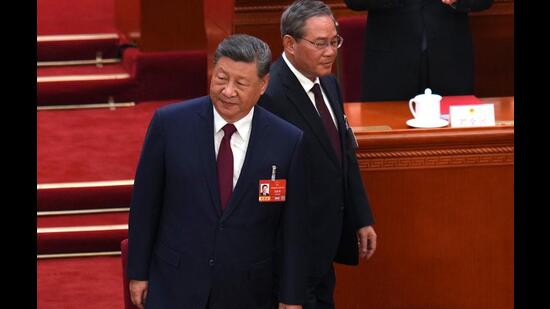
The annual legislative sessions of the Chinese People’s Consultative Conference (CPPCC) and the National People’s Congress (NPC) — known as the “two sessions” concluded on March 12. The annual government report presented by Premier Li Qiang signalled a broader continuity in economic policy while highlighting problems such as local debt and local cadre compliance with central directives. On the political front, however, the main news on the eve of the “two sessions”, was the revocation of the membership of more than a dozen officials of the People’s Liberation Army (PLA). This move, predicted by several analysts, comes against the backdrop of a high-profile purge announced earlier this year, of General Zhang Youxia, former Central Military Commission (CMC) vice-chairman and a close ally of President Xi Jinping, and General Liu Zhenli, the chief of staff of the CMC.
What do these purges indicate about the stability of the Chinese political system and about the Communist Party of China (CPC) general secretary and CMC chairman Xi’s grasp on power?
The PLA purges have created tremors across the CPC. Following the January announcement of the two arrests, local- and provincial-level “two sessions” meetings that lead up to the national-level meetings in March pledged to “unite more closely around the Party Central Committee with Comrade Xi Jinping at its core”.
In some cases, these expressions of political loyalty may be the result of proactive efforts by lower-ranking leaders to avoid repercussions against those who do not explicitly declare such loyalty. But, by and large, these articulations of support are the result of active mobilisation for Xi by the party-State hierarchy at a politically sensitive juncture. The livestreaming of these online meetings from different branches and service headquarters of the PLA — a break from the usual practice — on the eve of the Chinese Lunar New Year was a deliberate effort by the PLA leadership to reach out to the rank and file.
Following the 20th CPC Congress in 2022, Xi appeared to delegate responsibilities in key policy areas to trusted loyalists. For example, Premier Li became more active in foreign affairs on Xi’s behalf, attending multilateral meetings — Li’s attendance at the 2023 G20 summit in New Delhi was a case in point — and meeting foreign dignitaries. Similarly, in other policy areas, such as the economy and ideology, Xi increasingly relied on CPC Politburo member He Lifeng and Politburo Standing Committee member Cai Qi, respectively.
“Inspection visits” by senior leaders to localities and organisations are a regular feature of the CPC political system, aimed at auditing performance and ensuring party discipline; speeches are made and instructions issued at these forums to convey the party line. In the aftermath of the January announcement, Xi has used these mechanisms to indicate a continued ability to impose his will and to be the decisive voice amidst competing views and interests. He, therefore, retains the ability to mobilise and marshal the CPC apparatus. If anything, the fact that the anti-corruption campaign has run for so long and that practically the entire CMC has been decimated since the 20th Party Congress suggests that despite the tensions and upheaval that such purges generate, the party-State is able to find equilibrium quickly.
This equilibrium is the result of strong institutional mechanisms that the CPC’s civilian leadership under Xi taps for political communication and discourse management. On February 23, a month after Zhang’s and Liu’s dismissals, the CPC Central Committee announced a new education campaign that is expected to end only in July 2026. There is already a new book by Xi published for study during the campaign, which is being managed by the Leading Small Group on Party Building, headed by Xi’s close ally, Cai Qi. The campaign is aimed at dominating political discourse across the Party by developing “correct views of political achievements”.
Official media reports suggest that, among other things, it also focuses on selecting the right kind of cadres in the run-up to the 21st Party Congress at the end of 2027. Local CPC, political advisory, and legislative bodies have already started the selection process, which will culminate next year with a new central committee and leadership in China.
Xi’s anti-corruption campaign has felled hundreds of senior cadres since its inception in 2013. The first question that arises is whether corruption is so serious that it extends right to the top. This might well be possible, but if it is so, it does not logically seem possible that it could have been rooted out completely in the decade and more since the campaign began — even the replacements of those currently purged are likely to be tainted in some way. Xi must have known this about the generals he appointed and must be aware of this for the generals he will now appoint.
The next question is: What do the charges against Zhang and Liu — “serious violations of discipline and law” — mean? Once again, logically, this can only mean either differences of opinion with Xi or an inability to follow his instructions fully or both. This seems reasonable — elite coherence is difficult in complex political systems at the best of times and perhaps even more difficult when China is a rising power in a world witnessing “changes unseen in a century”, as Xi regularly declares.
If so, these purges are not a sign of weakness but an indication of civilian supremacy in China and of Xi’s desire to ensure that the Chinese military becomes ever more capable of achieving the party-State’s political and military objectives.
Devendra Kumar is associate fellow and Jabin T Jacob is director at the Centre of Excellence for Himalayan Studies, School of Humanities and Social Sciences,Shiv Nadar Institution of Eminence, Delhi-NCR. The views expressed are personal


