
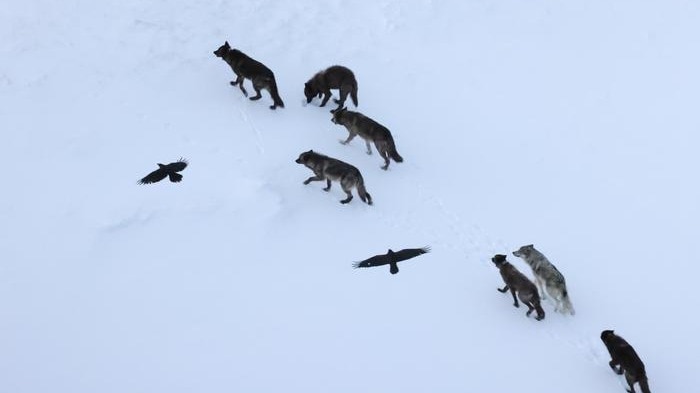
How do ravens find wolf kills before the blood dries? We now know

For decades, scientists assumed they knew how ravens always managed to show up at a wolf kill before the blood had even dried. The birds must be following the wolves, they had long assumed.

That assumption has now been debunked and replaced with something far more intriguing.

A new research study based on tracking ravens and wolves in Yellowstone National Park over two and a half years shows that ravens use spatial memory to find food, returning from long distances to areas where wolf kills are most likely to occur.

The study, published in the journal Science, was led by the Research Institute of Wildlife Ecology at the University of Veterinary Medicine Vienna and the Max Planck Institute of Animal Behaviour in Germany.
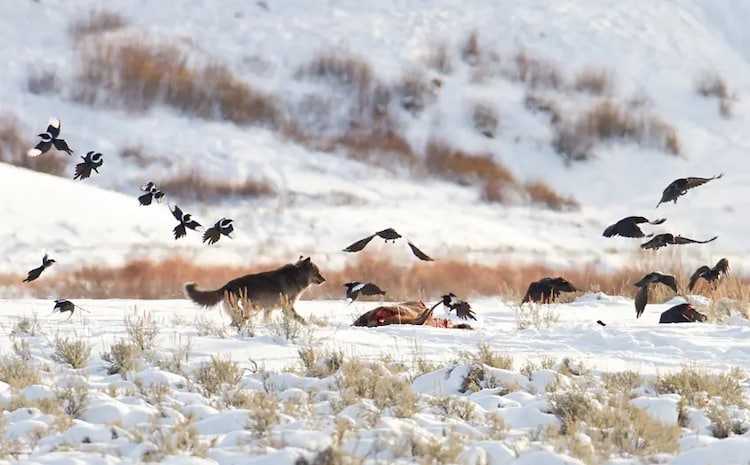
A wolf chases magpies and ravens from an elk carcass. (Photo: Yellowstone National Park)

A wolf chases magpies and ravens from an elk carcass. (Photo: Yellowstone National Park)

HOW DO RAVENS FOLLOW WOLVES?

The team attached tiny GPS tracking devices to 69 ravens, “which is just an insane number,” said Dr Matthias Loretto, the study’s first author.

Along with the ravens, monitoring movement data was also collected from 20 of Yellowstone’s GPS-collared wolves over winter months.

The data included recorded locations at intervals of up to 30 minutes for ravens and up to one hour for wolves.

What they found surprised them. Over two and a half years of tracking, researchers found only one clear case of a raven following a wolf for more than one kilometre or more than an hour.

“At first, we were puzzled,” said Loretto. “Once we realised that ravens are not following wolves over long distances, we couldn’t explain why the birds still arrive so quickly at wolf kills.”
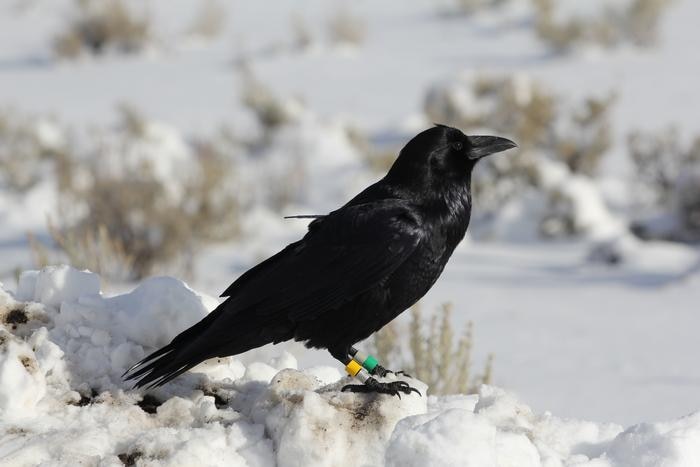
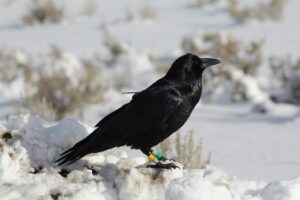
The team fitted ravens with GPS backpacks, seen here with antenna protruding. (Photo: Matthias Loretto)

The team fitted ravens with GPS backpacks, seen here with antenna protruding. (Photo: Matthias Loretto)

The answer, it turned out, had less to do with stalking and more associated with memory.

Rather than tracking predators directly, ravens repeatedly revisited specific areas where wolf kills were historically common, like flat valley bottoms where wolves hunt more successfully.

Some ravens flew up to 155 kilometres in a single day, toward places where a carcass was likely to appear, even though the exact timing of a kill is unpredictable.

“We already knew that ravens can remember stable food sources, like landfills,” said Loretto. “What surprised us is that they also seem to learn in which areas wolf kills are more common. A single kill is unpredictable, but over time some parts of the landscape are more productive than others — and ravens appear to use that pattern to their advantage.”

HOW DOES IT MATTER?

The study reframes how scientists think about scavenger behaviour more broadly.

“What our study clearly shows is that ravens are flexible in where they decide to feed. They don’t stay tied to a particular wolf pack. With their sharp senses and memory of past feeding locations, they can choose among many foraging opportunities far and wide,” said senior author John M Marzluff of the University of Washington.

“This changes how we think about how scavengers find food — and suggests we may have underestimated some species for a long time.”
Latest

US startup wants to sell sunlight at $5,000/hour, send 50,000 big mirrors to space — the idea is controversial

California-based Reflect Orbital has proposed deploying 50,000 large mirrors into orbit around Earth. The company wants to sell sunlight — brighting up the ni

Iran launches Sejjil missile against US: Why is it called the dancing missile?

The missile can carry a payload of around 500-1,000 kilograms, which may include conventional high-explosive warheads and potentially other types depending on c

Snowing in March: Unseasonal snowfall could enhance Ladakh’s water crisis

In the past, heavy snow arrived between December and February and stayed long enough to recharge underground water and keep springs flowing through summer. Now

Indian scientists discover how meditation rewires the brain

Scientists discovered that experienced meditators also exhibit higher activity in the gamma frequency range, which is associated with attention, perception and

Collision of two planets seen from Earth reveals big secret about our Moon

The collision bears a striking resemblance to the one thought to have created the Earth and Moon about 4.5 billion years ago.

Topics

The Iran war is roiling commodities far beyond oil

The Gulf states, it is rapidly becoming clear, matter for the supply of much more than oil and gas.

Renault bets on Duster revival to power India turnaround

The original Renault Duster, launched more than a decade ago, effectively created the compact SUV category in India.

Reliance, Samsung sign $3-billion contract for green ammonia supply

The Reliance-Samsung deal, one of the largest of its kind globally, signals Chairman Mukesh Ambani's ambition to dominate the renewable energy value chain.

Sensex, Nifty set for muted open today due to higher-for-longer crude oil prices

Brokerages Citi and Nomura have lowered their year-end Nifty 50 targets, citing the impact of the surge in crude oil prices on India's growth and earnings.

Actor Navnindra Behl, known for Ishqbaaz, Queen, dies at 76; son Kanu Behl pens moving note: ‘Until you birth me again’

Veteran actor Navnindra Behl, best known for her work in Ishqbaaz and Bollywood film Queen, passed away at the age of 76. 

Hema Malini says ‘it’s a shame’ Dharmendra was left out of Oscars In Memoriam segment: ‘He was recognised everywhere’

Hema Malini criticised the Oscars for not including Dharmendra in the In Memoriam segment, stating that the late actor meant so much to people worldwide.

Pay first, fill later: Oil marketing firms suspend fuel on credit to pumps amid West Asia crisis

Oil marketing companies (OMCs) have suspended fuel on credit to limit offtake by retail outlets, four people aware of the development said.

‘Firms need to move to adaptive, energy-efficient AI models’

Sarah Hooker is convinced that the future lies in AI systems that use less computing power, cost less to run and can adapt to the needs of users.
spot_img

Related Articles

Popular Categories

spot_imgspot_img

